Dr Jesse Garrison, FRAS
Historian of Science | PhD History and Philosophy of Science (UCL 2026)
I'm a historian of science specialising in the history of astronomy and mathematics in the nineteenth century.
My PhD thesis, British Solar Eclipse Expeditions in the Nineteenth Century (UCL 2026), offered the first chronological examination of nineteenth-century British solar eclipse expeditions. Drawing on extensive archival research across multiple institutions, I investigated the administration and planning behind eclipse fieldwork. By contextualising individual expeditions within the framework of a larger scientific enterprise, rather than treating them in isolation, my thesis revealed new continuities between expeditions, uncovered the contributions of previously unacknowledged individuals, and demonstrated the importance of scientific administration — even in the absence of scientific success — in establishing a precedent of state support for eclipse research.
Recently, I was a Research Assistant in the UCL Department of Mathematics, where I conducted archival research into the department's history as part of the UCL200 celebrations. This project examined the department's founding and early history, UCL's evolving role within British mathematics, and the experiences and contributions of the first women to study mathematics at UCL, published on the Department's website.
Before turning to history, I obtained a degree in astrophysics from University of Colorado Boulder and conducted research in astronomy and solar physics. At the Laboratory for Atmospheric and Space Physics, I performed computer modelling of the upper atmosphere of the M-dwarf exoplanet host star GJ 832. At the Center for Astrophysics and Space Astronomy, I helped confirm the discovery of a new nova located in M31. See Publications for further details.
I am also a Fellow of the Royal Astronomical Society.
Selected Publications
A selection of my publications is listed below; for the full list, see Publications.
Selected Publications
A selection of my publications is listed below; for the full list, see Publications.
Towards a Global History of the 1860 Total Solar Eclipse
Deborah Kent, Jesse Garrison, Megan Briers, Ileana Chinnici, Frédéric Soulu, and Daniel Belteki
HoST - Journal of History of Science and Technology 19, no. 1 (2025)
Abstract
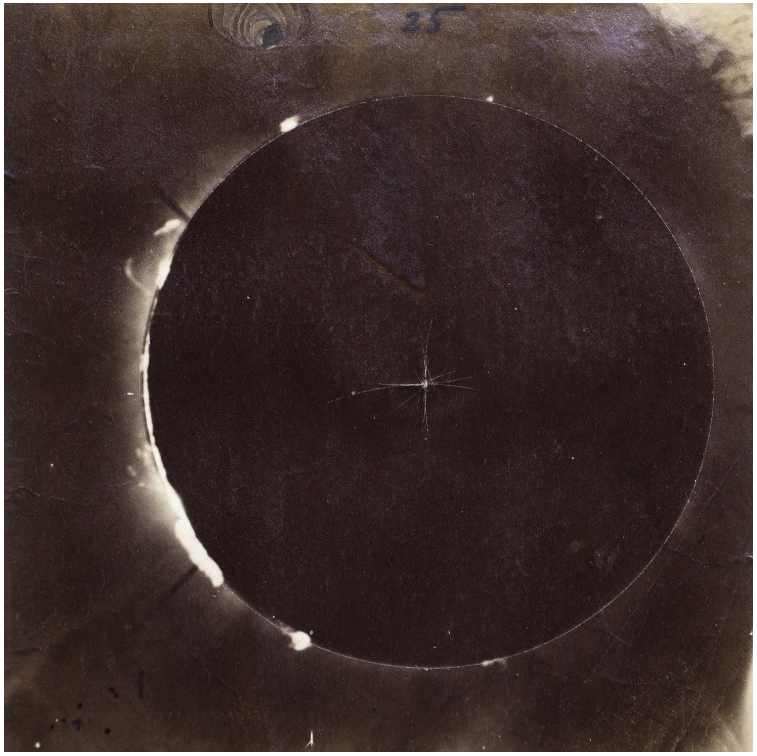
The path of eclipse totality across North America, Spain, and Northern Africa on 18 July 1860 was accessible to a wide range of observers in diverse geographical and socio-political contexts, the infrastructures of which shaped individual expedition logistics. This joint paper combines in a single frame of reference accounts from British, French, Spanish, Portuguese, Italian, Algerian, and North American expedition parties. A focus on the scientific objectives of these observers with varied circumstances, institutions, and funding sources raises the question of a global approach to the history of observing the total solar eclipse in 1860.
The path of eclipse totality across North America, Spain, and Northern Africa on 18 July 1860 was accessible to a wide range of observers in diverse geographical and socio-political contexts, the infrastructures of which shaped individual expedition logistics. This joint paper combines in a single frame of reference accounts from British, French, Spanish, Portuguese, Italian, Algerian, and North American expedition parties. A focus on the scientific objectives of these observers with varied circumstances, institutions, and funding sources raises the question of a global approach to the history of observing the total solar eclipse in 1860.
Towards a Global History of the 1860 Total Solar Eclipse
Deborah Kent, Jesse Garrison, Megan Briers, Ileana Chinnici, Frédéric Soulu, and Daniel Belteki
HoST - Journal of History of Science and Technology 19, no. 1 (2025)
Abstract
The path of eclipse totality across North America, Spain, and Northern Africa on 18 July 1860 was accessible to a wide range of observers in diverse geographical and socio-political contexts, the infrastructures of which shaped individual expedition logistics. This joint paper combines in a single frame of reference accounts from British, French, Spanish, Portuguese, Italian, Algerian, and North American expedition parties. A focus on the scientific objectives of these observers with varied circumstances, institutions, and funding sources raises the question of a global approach to the history of observing the total solar eclipse in 1860.
The path of eclipse totality across North America, Spain, and Northern Africa on 18 July 1860 was accessible to a wide range of observers in diverse geographical and socio-political contexts, the infrastructures of which shaped individual expedition logistics. This joint paper combines in a single frame of reference accounts from British, French, Spanish, Portuguese, Italian, Algerian, and North American expedition parties. A focus on the scientific objectives of these observers with varied circumstances, institutions, and funding sources raises the question of a global approach to the history of observing the total solar eclipse in 1860.
One of a Kind: A Unique Coulomb Torsion Balance with Modifications in the Collections of the Deutsches Museum, Munich
Elisabetta Rossi, Daniel Liu, Jesse Garrison, and Julien Gressot
Bulletin of the Scientific Instrument Society, no. 166 (2025)
Abstract
Every scientific instrument is more than just a tool—it is a trace of human curiosity, craft, and historical, cultural, and scientific context. Behind its material form lies a network of stories: the hands that built it, the minds that used it, the questions it was meant to answer, and the intellectual climate of its time. Occasionally, an object carries with it a deeper sense of enigma—an unsolved puzzle that invites further investigation.
Every scientific instrument is more than just a tool—it is a trace of human curiosity, craft, and historical, cultural, and scientific context. Behind its material form lies a network of stories: the hands that built it, the minds that used it, the questions it was meant to answer, and the intellectual climate of its time. Occasionally, an object carries with it a deeper sense of enigma—an unsolved puzzle that invites further investigation.
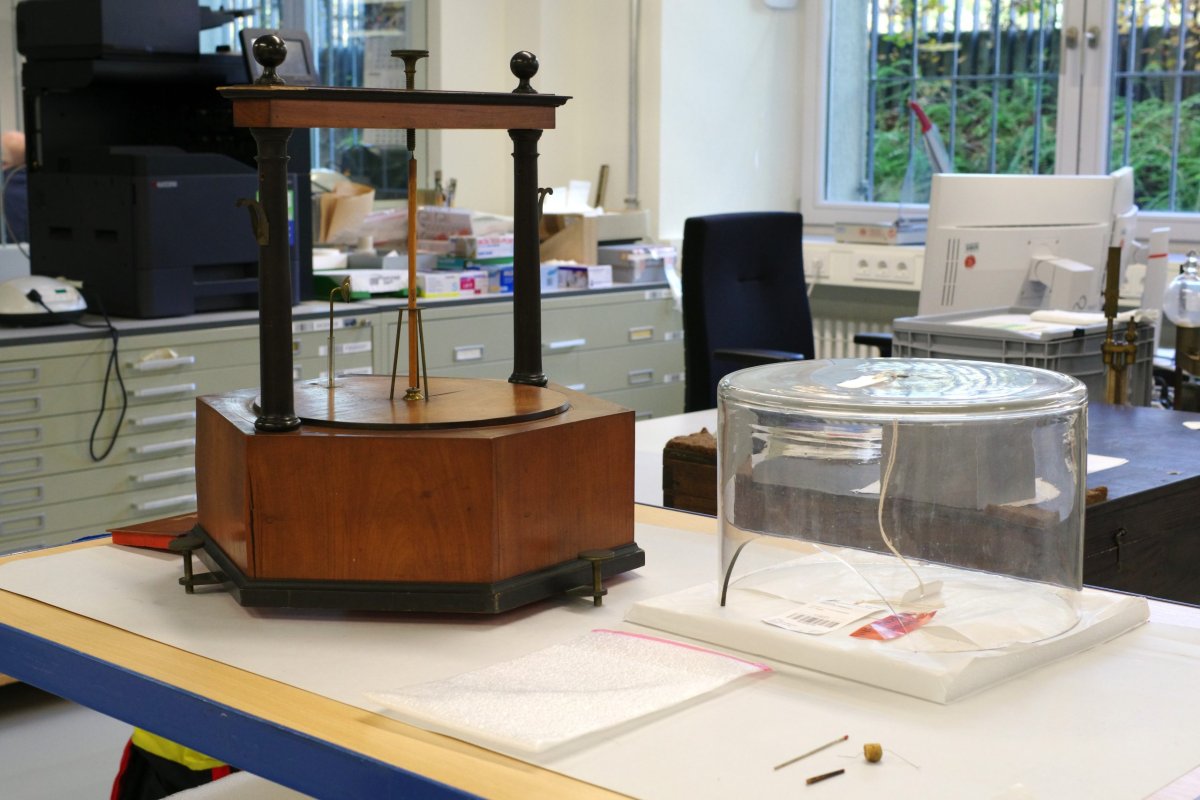
This article traces the history of one such enigmatic object: a 19th-century apparatus for measuring electrical phenomena, housed today in the historical collections of the Deutsches Museum (DM) in Munich, though it is not currently on display. We shall refer to it hereafter as DM 1182. The museum catalogue describes it as a modified Coulomb torsion balance—yet a closer look reveals that this instrument significantly diverges in structure from the well-known torsion balance devised by Charles-Augustin de Coulomb (1736–1806) to investigate electrostatic forces.
One of a Kind: A Unique Coulomb Torsion Balance with Modifications in the Collections of the Deutsches Museum, Munich
Elisabetta Rossi, Daniel Liu, Jesse Garrison, and Julien Gressot
Bulletin of the Scientific Instrument Society, no. 166 (2025)
Bulletin of the Scientific Instrument Society, no. 166 (2025)
Abstract
Every scientific instrument is more than just a tool—it is a trace of human curiosity, craft, and historical, cultural, and scientific context. Behind its material form lies a network of stories: the hands that built it, the minds that used it, the questions it was meant to answer, and the intellectual climate of its time. Occasionally, an object carries with it a deeper sense of enigma—an unsolved puzzle that invites further investigation.
This article traces the history of one such enigmatic object: a 19th-century apparatus for measuring electrical phenomena, housed today in the historical collections of the Deutsches Museum (DM) in Munich, though it is not currently on display. We shall refer to it hereafter as DM 1182. The museum catalogue describes it as a modified Coulomb torsion balance—yet a closer look reveals that this instrument significantly diverges in structure from the well-known torsion balance devised by Charles-Augustin de Coulomb (1736–1806) to investigate electrostatic forces.
Semi-Empirical Modeling of the Photosphere, Chromosphere, Transition Region, and Corona of the M-Dwarf Host Star GJ 832
J. M. Fontenla, Jeffrey L. Linsky, Jesse Garrison, Kevin France, A. Buccino, Pablo Mauas, Mariela Vieytes, and Lucianne M. Walkowicz
The Astrophysical Journal 830, no. 2 (2016)
Abstract
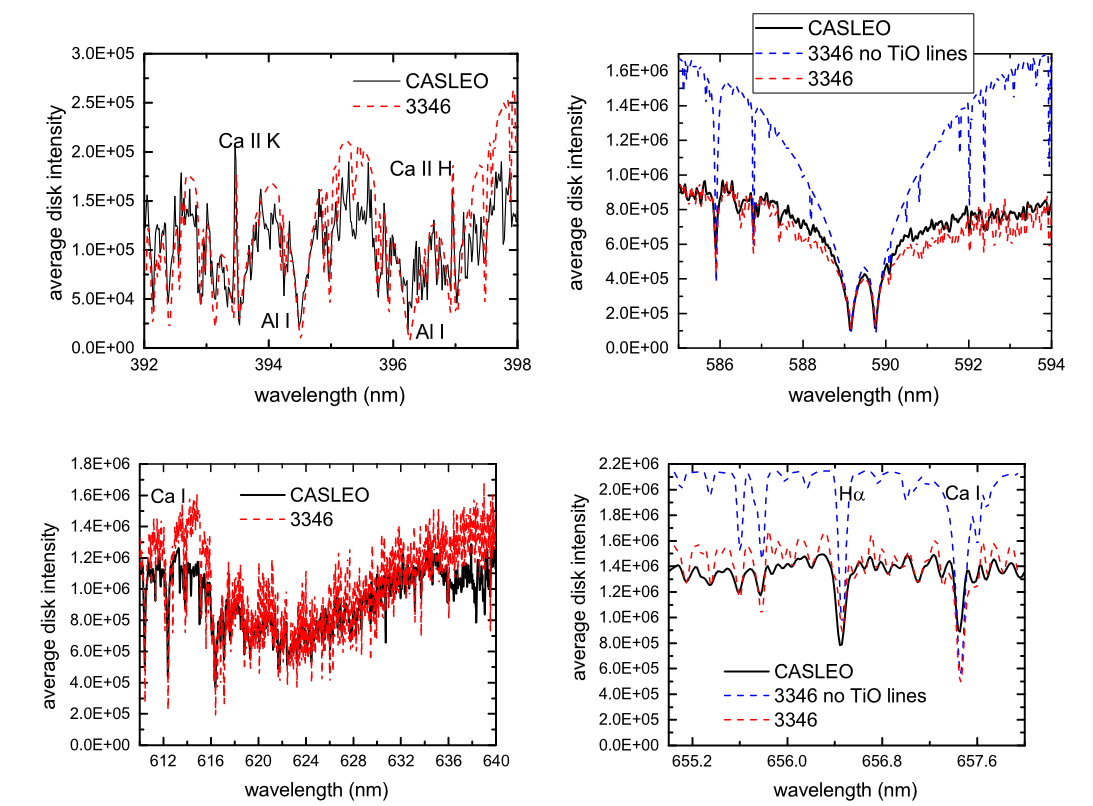
Stellar radiation from X-rays to the visible provides the energy that controls the photochemistry and mass loss from exoplanet atmospheres. The important extreme ultraviolet (EUV) region (10–91.2 nm) is inaccessible and should be computed from a reliable stellar model. It is essential to understand the formation regions and physical processes responsible for the various stellar emission features to predict how the spectral energy distribution varies with age and activity levels. We compute a state-of-the-art semi-empirical atmospheric model and the emergent high-resolution synthetic spectrum of the moderately active M2 V star GJ 832 as the first of a series of models for stars with different activity levels. We construct a one-dimensional simple model for the physical structure of the star’s chromosphere, chromosphere-corona transition region, and corona using non-LTE radiative transfer techniques and many molecular lines. The synthesized spectrum for this model fits the continuum and lines across the UV-to-optical spectrum. Particular emphasis is given to the emission lines at wavelengths that are shorter than 300 nm observed with the Hubble Space Telescope, which have important effects on the photochemistry of the exoplanet atmospheres. The FUV line ratios indicate that the transition region of GJ 832 is more biased to hotter material than that of the quiet Sun. The excellent agreement of our computed EUV luminosity with that obtained by two other techniques indicates that our model predicts reliable EUV emission from GJ 832. We find that the unobserved EUV flux of GJ 832, which heats the outer atmospheres of exoplanets and drives their mass loss, is comparable to the active Sun.
Stellar radiation from X-rays to the visible provides the energy that controls the photochemistry and mass loss from exoplanet atmospheres. The important extreme ultraviolet (EUV) region (10–91.2 nm) is inaccessible and should be computed from a reliable stellar model. It is essential to understand the formation regions and physical processes responsible for the various stellar emission features to predict how the spectral energy distribution varies with age and activity levels. We compute a state-of-the-art semi-empirical atmospheric model and the emergent high-resolution synthetic spectrum of the moderately active M2 V star GJ 832 as the first of a series of models for stars with different activity levels. We construct a one-dimensional simple model for the physical structure of the star’s chromosphere, chromosphere-corona transition region, and corona using non-LTE radiative transfer techniques and many molecular lines. The synthesized spectrum for this model fits the continuum and lines across the UV-to-optical spectrum. Particular emphasis is given to the emission lines at wavelengths that are shorter than 300 nm observed with the Hubble Space Telescope, which have important effects on the photochemistry of the exoplanet atmospheres. The FUV line ratios indicate that the transition region of GJ 832 is more biased to hotter material than that of the quiet Sun. The excellent agreement of our computed EUV luminosity with that obtained by two other techniques indicates that our model predicts reliable EUV emission from GJ 832. We find that the unobserved EUV flux of GJ 832, which heats the outer atmospheres of exoplanets and drives their mass loss, is comparable to the active Sun.
Semi-Empirical Modeling of the Photosphere, Chromosphere, Transition Region, and Corona of the M-Dwarf Host Star GJ 832
J. M. Fontenla, Jeffrey L. Linsky, Jesse Garrison, Kevin France, A. Buccino, Pablo Mauas, Mariela Vieytes, and Lucianne M. Walkowicz
The Astrophysical Journal 830, no. 2 (2016)
The Astrophysical Journal 830, no. 2 (2016)
Abstract
Stellar radiation from X-rays to the visible provides the energy that controls the photochemistry and mass loss from exoplanet atmospheres. The important extreme ultraviolet (EUV) region (10–91.2 nm) is inaccessible and should be computed from a reliable stellar model. It is essential to understand the formation regions and physical processes responsible for the various stellar emission features to predict how the spectral energy distribution varies with age and activity levels. We compute a state-of-the-art semi-empirical atmospheric model and the emergent high-resolution synthetic spectrum of the moderately active M2 V star GJ 832 as the first of a series of models for stars with different activity levels. We construct a one-dimensional simple model for the physical structure of the star’s chromosphere, chromosphere-corona transition region, and corona using non-LTE radiative transfer techniques and many molecular lines. The synthesized spectrum for this model fits the continuum and lines across the UV-to-optical spectrum. Particular emphasis is given to the emission lines at wavelengths that are shorter than 300 nm observed with the Hubble Space Telescope, which have important effects on the photochemistry of the exoplanet atmospheres. The FUV line ratios indicate that the transition region of GJ 832 is more biased to hotter material than that of the quiet Sun. The excellent agreement of our computed EUV luminosity with that obtained by two other techniques indicates that our model predicts reliable EUV emission from GJ 832. We find that the unobserved EUV flux of GJ 832, which heats the outer atmospheres of exoplanets and drives their mass loss, is comparable to the active Sun.